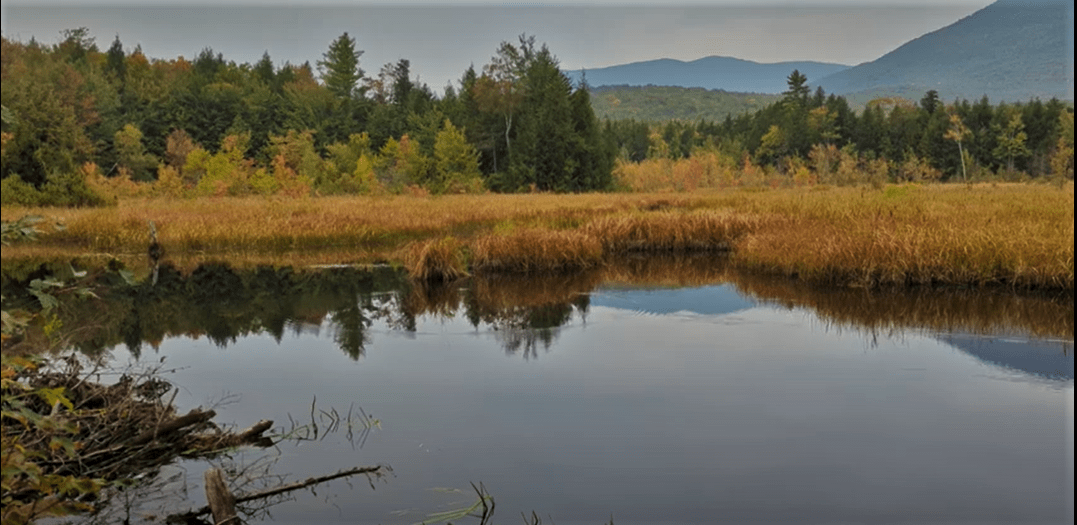
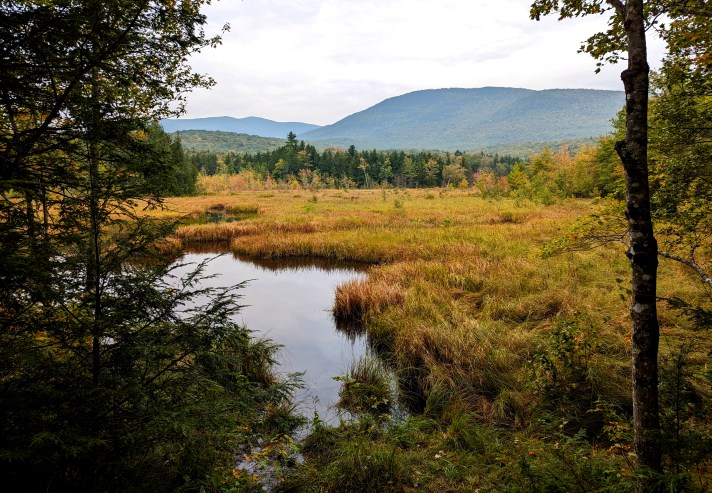
I recently visited this beaver pond (above) in the Sandwich Range of the White Mountains of New Hampshire. A friend, Tom Gamper, and I hiked to the high end of this meadow to see the source of the pond and found two other dams, creating a series of ponds on the way to the one you see in this first photo. Beavers created the entire system from a small mountain brook. (Photo below).
Before beavers were almost trapped out of existence, they shaped the American landscape. They built dams and ponds, and the ponds became habitat for waterfowl and fish, aquatic insects, amphibians and reptiles. The ponds and the land around the ponds stored water so that many of the creeks ran cold, providing year-round habitat for the Eastern brook trout. Water filtered slowly through the East Coast dams and flowed downstream to the Atlantic.
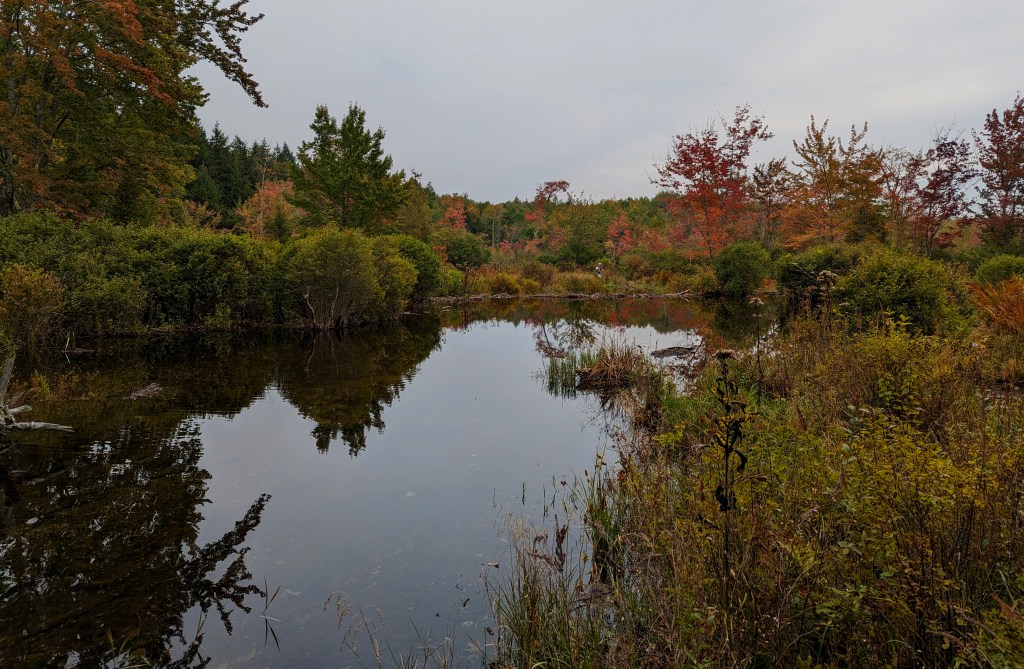
“Beavers need water, so they cut down trees and flood forests to create ponds,” writes Leila Philip in Beaver Land: How One Weird Rodent Made America. “In doing so, they kill trees but create new habitat for hundreds of animal species that rely on those new waterways. Once they abandon a dam, having determined that life there is no longer manageable due to lack of food, [the pond] begins to drain and grows back as meadow, then underbrush, then eventually forest, the soil enriched by years of accumulated pond rot and muck.”


There’s a growing naturalist movement behind the beaver, more so in Europe than in the United States. There’s a recognition that climate change causes more extreme weather — from floods to drought — and their advocates believe beavers can play a role in softening the effects of both.
Three years ago, Pickering, a town in the north of England long prone to flooding from a nearby river, reintroduced beavers for protection during heavy rains. Since then, the busy rodents have built what is reportedly the largest dam in the country, at nearly 80 yards, along with a series of smaller dams to further protect Pickering. It was as inexpensive and as unobtrusive a flood management plan as you can imagine. By contrast, conventional projects to protect river towns are hugely expensive.

Below is a photo I took last winter along a creek in Baltimore County, and you know that it was not always like this: Low water, a series of dry gravel beds, large stone blocks placed against the banks to slow its erosion, a single-stream creek, essentially a drainage ditch. To most people, Minebank Run in Cromwell Valley Park looks like any suburban creek, degraded by time, development and storm-water runoff upstream. It could really benefit from the recruitment of beavers. What if we planted trees and native plants that attract beavers to places like that? What if, instead of seeing them as a nuisance, we let them build the dams their ancestors would have built. What if, instead of a gravelly ditch, we saw a series of ponds and lush wetlands, with water slipping through the beaver dams on its way to the Chesapeake Bay? We could probably achieve what we’ve been after for years now — reduced erosion and sediment control, the restoration of wetlands and habitats — at a fraction of the cost we now spend on storm-water control and stream restoration.

Discover more from Dan Rodricks
Subscribe to get the latest posts sent to your email.

 Dan Rodricks
What beautiful photographs. I love watching the beavers around where I live. They are very industrious animals. I’m always sad when I see see one lying on the side of the road.
Hope you are doing well.
LL
>
LikeLiked by 1 person
Yes, beavers are engineers. That’s why the mascot of MIT in Cambridge, Massachusetts is a beaver.
MIT produces a lot of human engineers—civil, mechanical, electrical, chemical, and more.
MIT students, like beavers, are known for their perseverance and industriousness as well. 🙂
LikeLike
I have fished small streams for brookies my whole life and can assure you that the beaver has ruined many brook trout fisheries where native trout once thrived. They cut down the shade canopy, the waters warm up and the brook fills with silt. A brook trout’s best friend is a beaver trapper.
LikeLike
Thanks for the comment. Please cite where this has happened.
LikeLike
Dan, where i grew up. South-eastern N.H. Exeter, Kensington, Newfields and Epping to name a few. Development has taken its toll also.
Progress i guess…..
LikeLike
You know, when you look at North America’s natural history, somehow both beavers and brook trout thrived for a very long time.
LikeLike
One more comment: Farmers destroyed more brookie habitat than beavers ever did.
LikeLike
Dan,
Your blog is very well said. The beaver ponds in NH actually tend to create habitat for animals that share the woods with the beaver. The ponds themselves are wonderful filters of the water as it flows through the pond and out the dam. These ponds are in the mountains usually far from many anglers since it takes time to walk in and these ponds hold precious wild brook trout. The fishing in these ponds manage themselves and fisheries don’t necessarily need to get involved. Some of the mountain ponds are stocked by plane as well. I always say that spending a day on a beaver pond in the NH White Mountains is about as close to God as you will get.
Jay Boynton
LikeLiked by 1 person
If we only could possibly leave nature alone! Just a thought!
Remarkable workers— the beavers!
LikeLiked by 1 person
Thank-you for this clear, stunning, and beautiful reminder that all things are connected.
If you ever need an 7 minute play in which 3 beavers debate leaving their lodge for fear of humans, give me a hoot.
LikeLiked by 1 person