
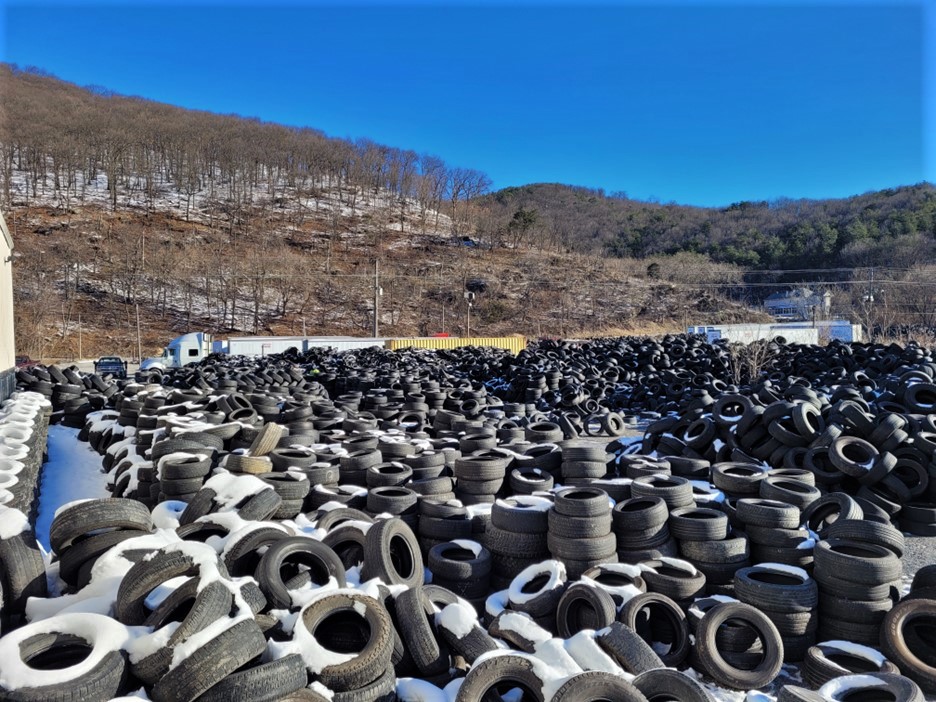
My son and I drove by this place in Westernport, Allegany County, a couple of months ago during a fishing trip and assumed it was a legit (and grotesque) tire dump. We were half right: It was grotesque but not legit.
On Dec. 18, a Maryland judge sentenced Michel Osei, 48, to 45 days in prison for the illegal dumping and abandonment of more than 250,000 scrap tires at a site along the North Branch of the Potomac River. My friend, Jim Burger, did the math: “That’s only .00018 days per tire.”
On October 16, Osei pleaded guilty to 17 environmental crimes: one count of unlawful disposal for gain, eight counts of operating a scrap tire facility without a license, and eight counts of improper handling of waste. Judge Jeffery S. Getty, sitting in Cumberland, sentenced Osei to 5 years of incarceration, suspending all but 45 days, five years of probation and a fine of $300,000 to the Maryland Clean Water Fund, all suspended.
The judge also ordered Osei to pay restitution of $250,000 to the Allegany County Commissioners. (That fact was originally reported by the Maryland AG’s staff as a suspended penalty.) While Osei’s prison time seems like a slap on the wrist, the quarter-million fine is not. Still, if sentencing is to be a deterrent, it would be wise for environmental crimes, especially one as outrageous as this, to result in more severe punishments.
One other comment: Allegany County would be wise to stop allowing industrial use of lands along the North Branch of the Potomac. The county should be pushing to turn an abandoned railroad into a hike-bike trail, and officials should be demanding the state provide more access for canoes, kayaks and rafts. The North Branch has been restored through the hard work of the Department of Natural Resources and to see the junky landscape along some of it is quite depressing and, more importantly, an opportunity for a new kind of economic development (recreation) missed. With more public access, there could be more jobs — restaurants, cafes, a brewery, a bike shop, a kayak shop, more river guides offering float trips for fishing, birding and photography — and more Marylanders could see their beautiful, restored river.
Here’s more on the Osei case from the Attorney General’s Office:
In June of 2021, Osei approached the Allegany County Office of Economic Development with a proposal to operate a scrap tire recycling facility in the county. Osei claimed the facility would eventually employ up to 50 people and already had millions of dollars of contracts to send the recycled tires overseas. The county offered a land-lease with favorable terms for an industrial parcel bordering the Potomac River. On July 19, 2021, Osei began operations at the facility. Osei and his employees collected more than 100,000 scrap tires from various locations in West Virgina. Those tires were taken to the facility in Westernport. Few, if any, tires were ever removed.
MDE inspectors first became aware of the operation on October 7, 2021. A site inspection and complaint documented approximately 10,000 to 15,000 scrap tires at that time. The property had no permits, and the tires were stored outside and uncovered, in piles that posed a significant fire hazard. MDE also contacted the Maryland State Office of the Fire Marshal due to the seriousness of the risk of fire.
Between the fall of 2021 and the spring of 2022, MDE and the Fire Marshal ordered Osei to stop operations on multiple occasions. When Osei ultimately abandoned the site in September 2022, it was estimated that more than 250,000 scrap tires remained on the site, strewn across the property and packed into tractor trailer containers. Allegany County has since started to clean up the site.
What the law says: Scrap tires are tires no longer suitable for their original purpose by virtue of wear, damage or defect. Scrap tires pose a number of health risks to people and the environment. They may only be transported by a licensed scrap tire hauler. Scrap tires may only be stored, sorted or processed at licensed facilities. MDE has a tiered license system that distinguishes between a “Secondary Scrap Tire Collection Facility,” which is authorized to store up to 1,500 scrap tires, and larger operations designated as either a “Primary Scrap Tire Acceptance Facility” or “Scrap Tire Recycler.” The larger facilities require a more detailed and thorough licensure and approval process similar to the installation of a solid waste acceptance facility or solid waste transfer station requiring review, notice, public hearing, and bonding.
Discover more from Dan Rodricks
Subscribe to get the latest posts sent to your email.

 Dan Rodricks
That picture is unreal.
LikeLiked by 1 person
After his 45 days Michel Osei should be required to load each tire in a wheelbarrow, push the wheelbarrow up hill to a pickup truck, where he loads them one by one. The tail gate of the truck can not be let down. Mr. Osie must lift the tires over the sides of the truck. He then drives the truck to a proper facility, unloads, and returns to finish clearing the land.
LikeLiked by 1 person
Follow the money – the defendant must have judge-shopped to get that light sentence
LikeLike
Dan,I loved today’s column . KurtSent via the Samsung Galaxy S22 5G, an AT&T 5G smartphone
LikeLiked by 1 person
Dan By today’s column I meant 12 29.Sent via the Samsung Galaxy S22 5G, an AT&T 5G smartphone
LikeLiked by 1 person