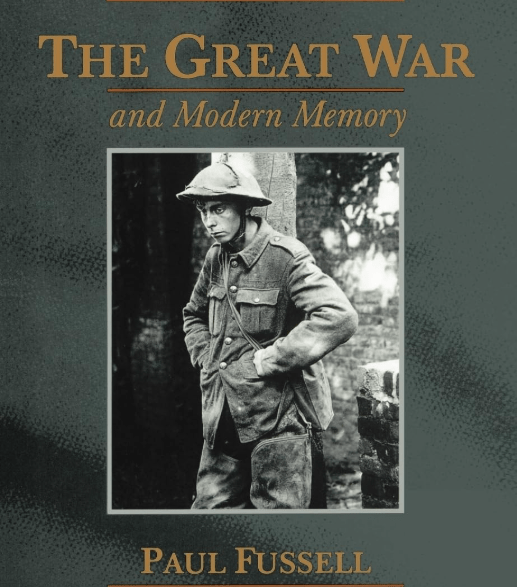
As a writer of non-fiction, the late Paul Fussell was one of the master distillers of the 20th Century, and by distiller I mean something like this: A writer who considers all — not only the general history of an examined period, but the cultural, political, social and commercial environment — and who extracts from all of that the essence of the times and its larger meanings. Most historians do this to some extent. Fussell did it on every page. He seemed to have a sixth sense for finding in the most minor, even mundane, detail — a playbill, a personal letter, a poem, a newspaper advertisement, an article of clothing — something surprisingly illustrative or, even better, ironic.

A reader will find the results of this method in his award-winning book, The Great War and Modern Memory, published 50 years ago this winter. You’ll find the same process and prose style in two other books, Class and Wartime. I read them all eagerly because of what I saw as not only remarkable writing talent but Fussell’s ability, as a true intellectual, to distill so many elements — British literature and lifestyle foremost — into a fascinating narrative unlike any book about World War I. And Fussell, a genuine curmudgeon, loved to find and exploit irony.
“Every war is ironic because every war is worse than expected,” goes the opening to The Great War and Modern Memory. “Every war constitutes an irony of situation because its means are so melodramatically disproportionate to its presumed ends.”
Dwight Garner, book critic of The Times, beat me to this praise of The Great War and Modern Memory. You can read his excellent essay at this gift link. The Modern Library placed Fussell’s tour de force at No. 75 on its list of the 100 best nonfiction books of the 20th century. That was in 1998, and I’m sure The Great War and Modern Memory is still on the list. It’s in my Top Ten. It’s a book about war, but also about the era, about the sensibilities ravaged in the horrid trenches across the farm fields of France.
Discover more from Dan Rodricks
Subscribe to get the latest posts sent to your email.

 Dan Rodricks
I totally agree with your assessment of Fussell. He was a consistently entertaining concise and hilarious writer. He and my father shared almost an exactly contemporaneous combat experience and irreverence for all things military. Indeed I think Fussell was the only writer on military affairs who made sense to my father. Which I think he would have recognized as an ultimate compliment
LikeLiked by 1 person
I loved the writing of Paul Fussell. He was a consistently articulate and hilarious writer. When I was young I loved the Great War and Modern Memory and Class. In my older years I found his accounts of his own combat experience and his contemporaries particularly poignant ( Doing Battle and The Child’s Crusade. He was an exact contemporary of my father whose combat experience in Europe and eventual disdain for all things military are astonishingly similar. Indeed I can give him the ultimate compliment that he was the writer whose military experience made the most sense to my father
Paul Schlitz Jr son of Paul Schlitz Sr 1924-2022
LikeLiked by 1 person