
Those of us who fish for sport like to have the whole place to ourselves. Arrive early enough at a favorite spot along a creek and you could be the first one there. That way, you get to cast into a familiar run before anyone else does. If that happens — if your fly is the first to hit the water just after dawn — you believe you’re at an advantage: The fish haven’t been spooked yet; they haven’t been beaten to boredom by an onslaught of 10 anglers who had the same idea you did and cast their flies to the same spot, hour after hour, until the fish retreated for the day.
Usually, being the first to fish, having the whole place to yourself, is a good thing.
Not so much in shad season.

When the annual migration of hickory and American shad commences — when they swim from the Atlantic into fresh water streams to spawn — the word gets out fast, and twice as fast as in the past because of social media. Good shad fishing is hardly ever solitary; when the fish are in abundance, anglers are pretty generous in sharing the water.
March 30 seemed early for the shad run; I associate the traditional start of it in the Chesapeake region with Tax Day, April 15. But climate change has skewed the fishing calendar a good deal.

The word went out on Facebook last week: The run is on.
Arriving at 8 am on Octoraro Creek on Sunday morning and finding the parking area empty and no one else fishing — that was reason for concern if not pessimism. We didn’t see any shad splashing or flashing silver in the water, either. Sometimes a place “seems fishy” even though you can’t spot fish. Octoraro did not seem that way, but we stepped in and started casting just the same.
You have to at least try.
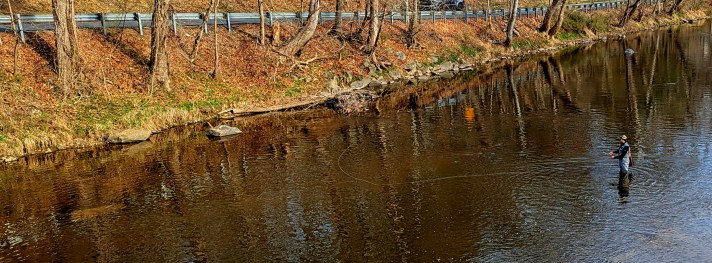
It was slow going for the first 20 minutes and then . . . a splash here, a flash there . . . and soon we were hooking up. Turns out, we did not have the place to ourselves after all. There were plenty of shad in the stream, and we might have been the first to greet them this spring.
We caught and released several silvery fish that had traveled 1,000 or more miles from the Atlantic to get to their natal waters. Shad fight hard and they can jump two feet out of the water as they try to throw your fly back at you, and some succeed. Every shad we caught swam away fast and strong when we released it. If it is necessary to touch them to remove the fly — something we try to avoid — you come away with the smell of ocean on your hand. Amazing, every year amazing: You stand hip deep in freshwater, sharing the creek with visitors from the salt.
Note to readers: Please consider joining me on Substack — there’s no charge to subscribe to my newsletter of commentary there, and you’re likely to find other journalists who, like me, were previously associated with a daily newspaper or other news source.
Discover more from Dan Rodricks
Subscribe to get the latest posts sent to your email.

 Dan Rodricks
Enjoy Dan. My fishing days are over and I miss them. I got injured in the USMC and at age 84 my mobility is pretty limited. The good news is the Baltimore VA hospital takes great care of me. Best, Dr. jim mcgee Director of Psycholgy and Forensic Services Sheppard Pratt retired
LikeLiked by 1 person
Alas, finding shad roe is not easy. It’s been a few years and I miss it. Thanks for bringing back great food memories. And thanks for the catch and release.
LikeLiked by 1 person