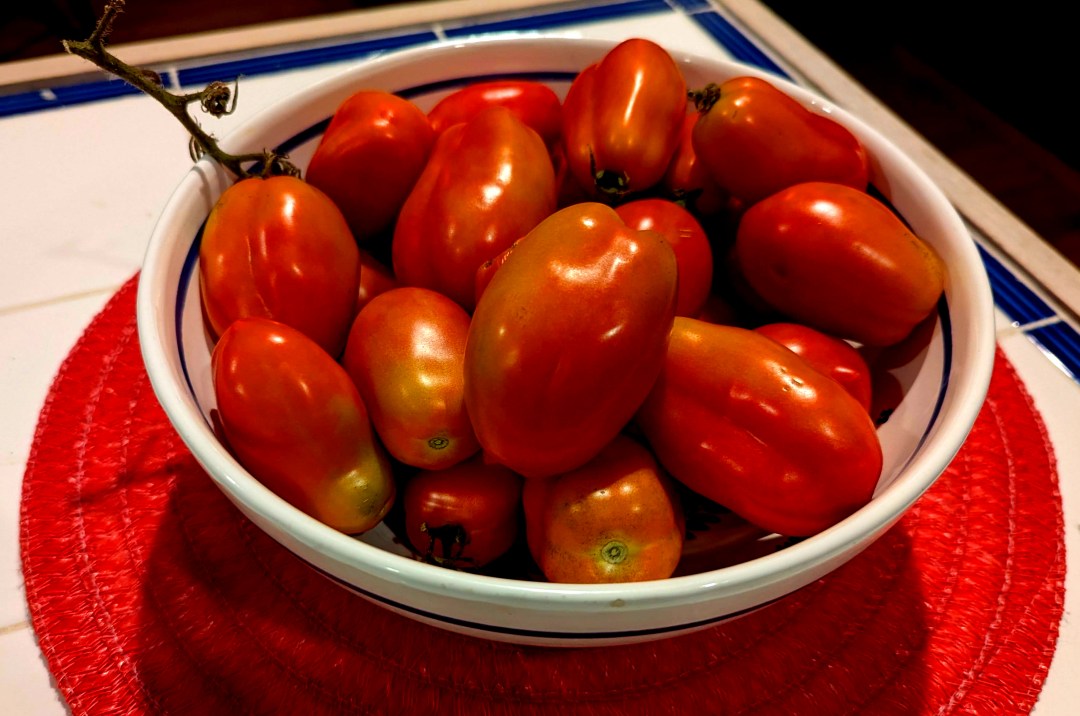
Our San Marzano tomatoes, the Champagne of plum tomatoes, are starting to come in, though apparently it’s a violation of European Union rules to call them San Marzano tomatoes when they are grown in a Baltimore backyard or anywhere other than in the Sarno Valley of Italy. The Italians will dispatch consiglieres and Carbiniere if you try to sell non-Sarno plum tomatoes as San Marzanos just as the French will send agents from the Comité Interprofessionnel du Vin de Champagne if you dare sell sparkling wine as Champagne.
Be that as it may — a phrase I have avoided using since my infamous Millard Fillmore Society speech of 1992 — this is a great tomato for sauce. In fact, it’s tops. The Roma tomato, also good, is a descendant of the San Marzano. I’ve grown both, but prefer the San Marzano when making simple marinara to can or freeze.
I wondered if there was a Saint Marzano to thank for this tomato. The closest saint I could find was probably an ancestor of one of America’s greatest heavyweight boxers. He was Saint Marcianus, also known as Saint Marciano, also known as Saint Marziano — these guys apparently used a lot of aliases — and he was a bishop martyred in the second century of Christianity. How was he martyred? My research so far has not provided that detail, though I’m sure you’d like to know.

Anyway, the name of Marciano jumped out at me since I was born in Brockton, Massachusetts, home of the Brockton Bomber, world heavyweight champ Rocky Marciano. His birth name was Rocco Marchegiano, but it was switched to the smoother Marciano because some dimwit ring announcer in Rhode Island had problems pronouncing the original.
So, now that I think of it, Rocky might not have been related to Saint Marciano at all, and besides, neither of them had anything to do with San Marzano tomatoes, which, as I look back, was the subject of this post.
Be that as it may, if you want a great sauce, look for San Marzanos. They come imported in 29-ounce cans. They are usually more expensive than other canned tomatoes, but worth it for a better-than-average spaghetti sauce. They’re the Champagne of plum tomatoes.
Discover more from Dan Rodricks
Subscribe to get the latest posts sent to your email.

 Dan Rodricks
I’ll stick with Amish paste.
LikeLike
Where do you get San Marzano tomato plants? And thanks for the light weight essay. News tends to be heavy and depressing so a post like this is always welcome.
LikeLiked by 2 people
We started ours from seed. Last year I found plants at a nursery in Baltimore, Greenfields.This tomato is great through the hottest days. It’s industrial strength but also flavorful and melts beautifully into a sauce.
LikeLike
Thanks. I’m in Hampden, so Greenfields is close by.
LikeLiked by 1 person
Dan, I love when you talk about such wonders as San Marzano tomatoes and your mother’s superb cooking and I assume that you are also an incredible chef yourself. Could I possibly barter with you for your marinara or other sauce? I possess myriad talents, but cooking is not one of them and your food articles leave me feeling Pavlovian.
LikeLiked by 1 person
I’d be glad to make you some, Devra.
LikeLiked by 1 person
Your agricultural skills are acknowledged heartily. We are growing heirlooms from seed and they are exploding as well right now. I don’t used them for sauce preferring their wine-like taste for salads at the moment…I think you should pot a few of the plants and use them as scenery for your next play…..Thank God for you, pal!
LikeLiked by 2 people
I am lucky to have planted one in the garden this year without knowing your praise. Hopefully my sauce will sing!
LikeLiked by 1 person