
I have a long fascination with World War I only because I find it so hideously absurd, one of human history’s foolish and costly eruptions of large-scale violence. It started in 1914 and ended on this date — at the 11th hour of the 11th day of the 11th month — in 1918. More than 70 million troops were mobilized, and 10 million of them died to fulfill dubious obligations and settle dubious disputes of the old monarchies. Another 10 million civilians were killed in those horrible years.
The French fought on their own soil to save their country from the invading Germans. France had a population of 39 million at the war’s outbreak — it is nearly 65 million today — and its population was considerably older than Germany’s. In the call to arms, men of all ages from all over France responded; they came from cities and small towns, from universities and from farms. The French anthropologist François Héran estimates that, out of 7.9 million French soldiers, around 1.5 million (18%) died during the war or within the six months that followed the armistice. World War I introduced an industrial form of killing, with heavy artillery, tanks, machine guns and deadly gas.
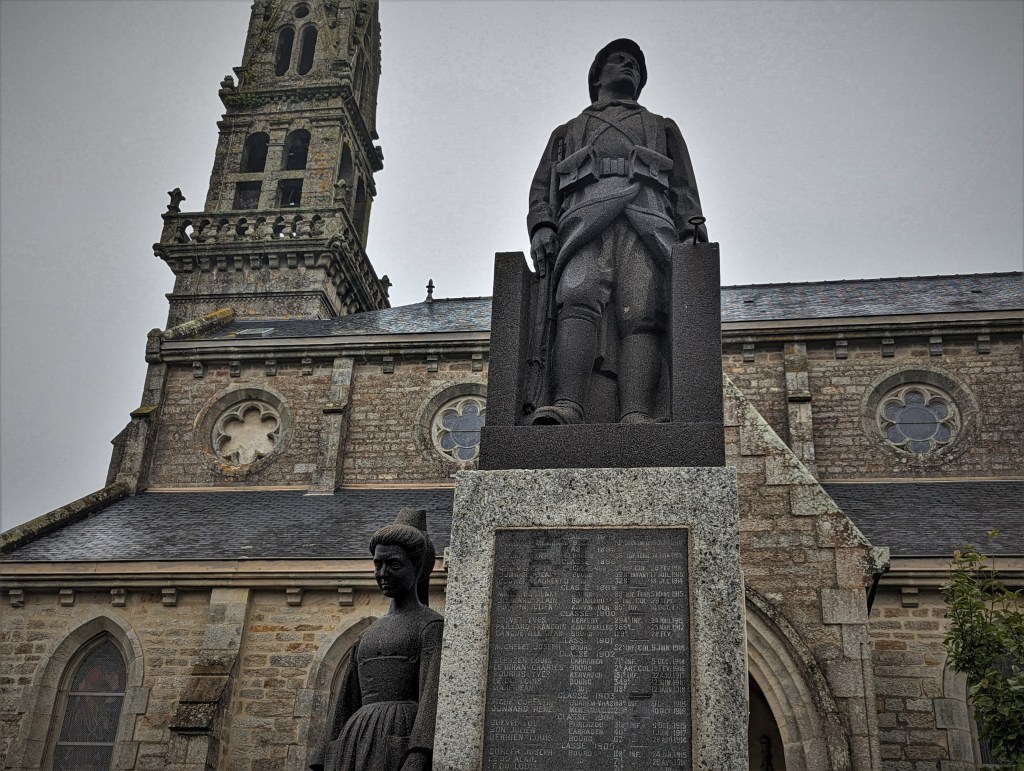
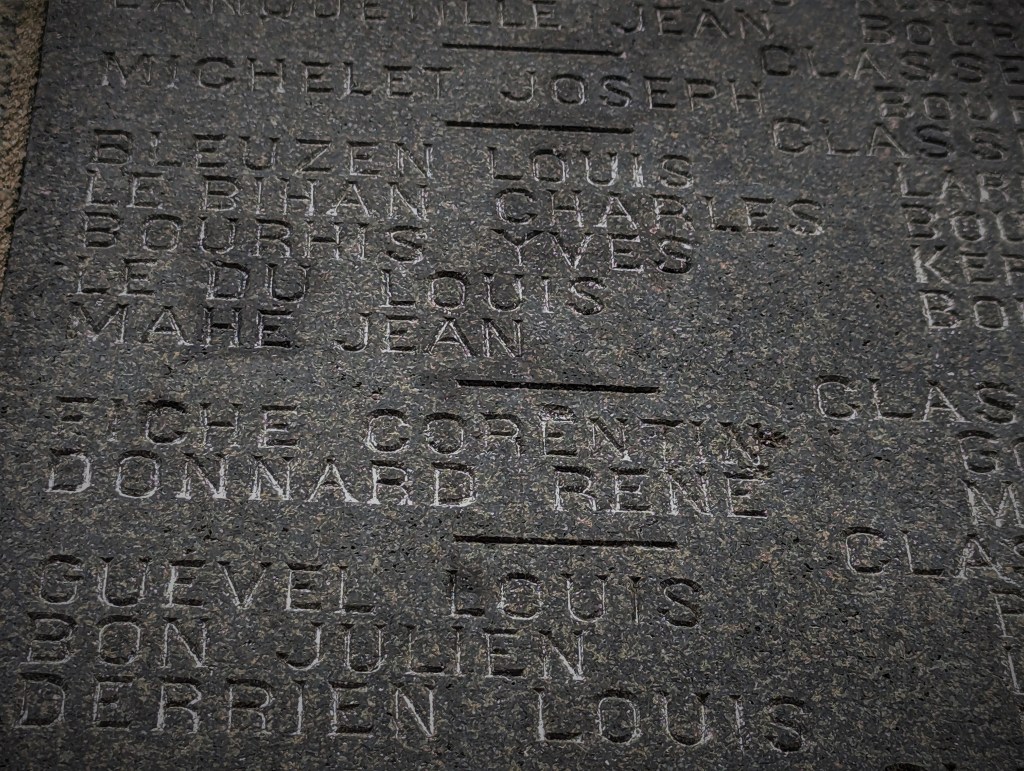
In Brittany, the birthplace of my in-laws in northwestern France, I found myself drawn to the World War I monuments in small towns. I discovered family names, familiar names, on the monument in Coray, a village in the county of Finistere. Its population today is just under 2,000; it was likely smaller in 1914. I counted 85 names of the war dead on a monument that bears the dark, sculptured likenesses of a French soldier and a Breton woman.
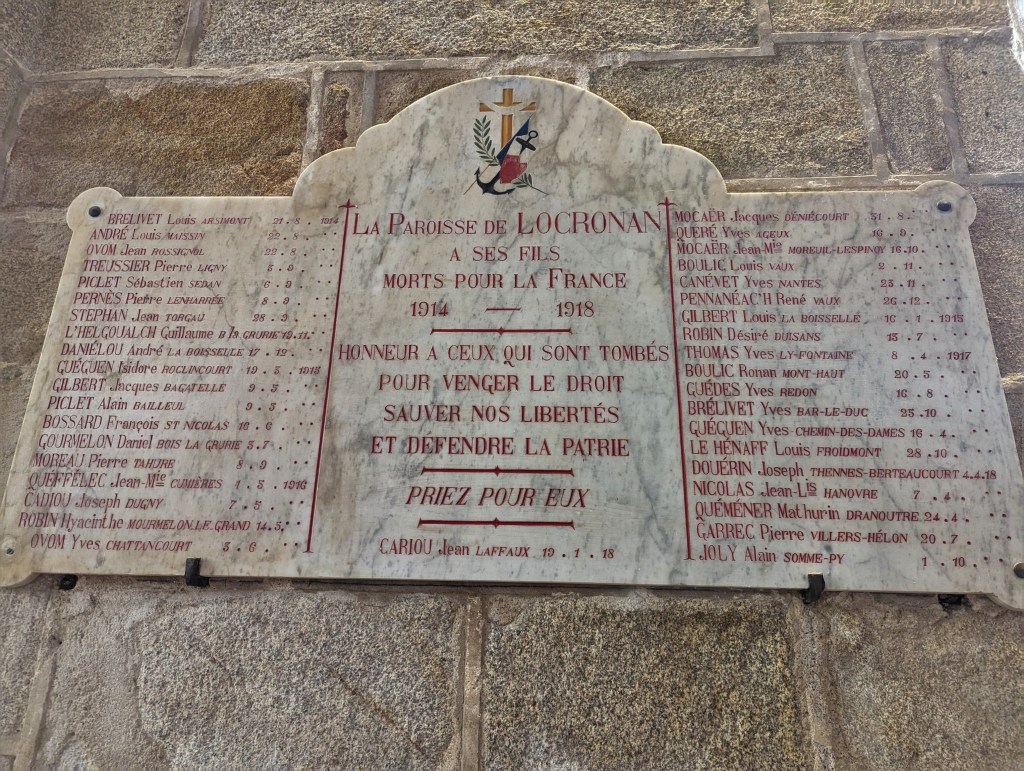
In the historic village of Locranon, with a population today of about 800, we found another World War I honor roll on the wall of the ancient church there. I counted 39 names.
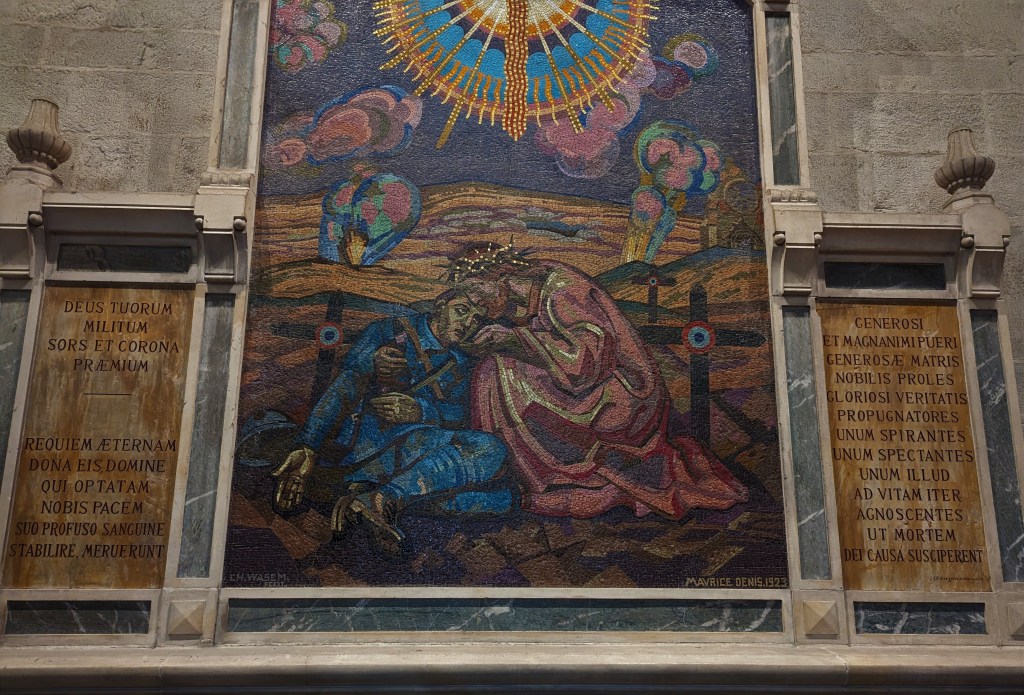
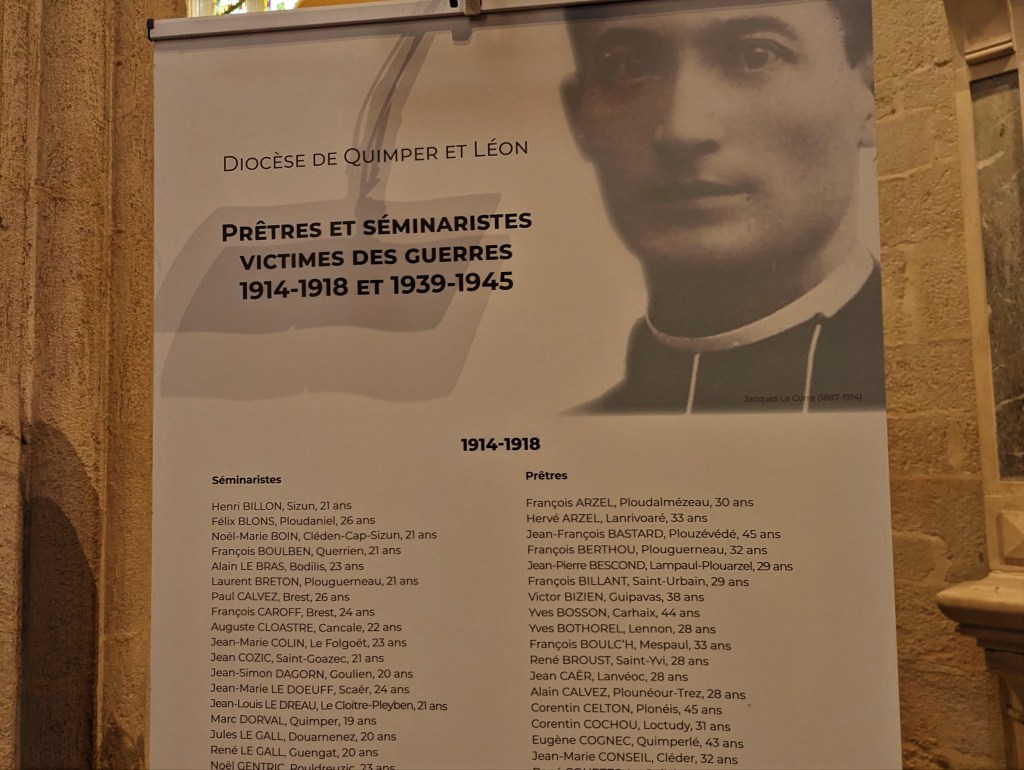
In the city of Quimper, in the Cathedral of Saint Corentin, there’s a mosaic of a mortally wounded French soldier being consoled by Christ as artillery shells explode in the battlefield behind them. Standing next to it is a modern honor roll of priests and seminarians, from the archdiocese of Quimper and Leon, who died in the first war and the one that started just 20 years later. There are dozens of names on the list. I didn’t feel like counting them. I wanted to leave the cathedral. I wanted to get outside, in the sunlight of a warm September day, and enjoy Quimper at peace in the modern world.
Paul Fussell, who wrote the best book on the Great War, opened with these words: “Every war is ironic because every war is worse than expected. Every war constitutes an irony of situation because its means are so melodramatically disproportionate to its presumed ends.” Fussell would see the same in our world today: One-hundred-and-five years after the “war to end all wars” we have war in Ukraine, war in the Middle East, civilians suffering and dying.
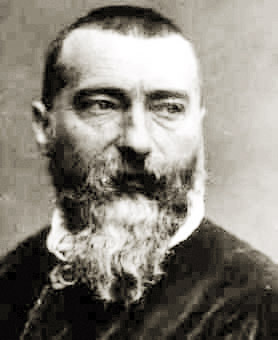
“Plus ça change, plus c’est la même chose.” Jean-Baptiste Alphonse Karr, a French journalist of the 19th Century known for sardonic wit, coined that gloomy phrase: “The more things change, the more they stay the same.” None of us want to believe such a thing, but the supporting evidence is strong.
Discover more from Dan Rodricks
Subscribe to get the latest posts sent to your email.


Hi, Dan. Great column. I share your interest in WWI, and its significance for the 20th century. In my travels in France, I saw similar monuments in every town and village, which listed so many names of young men from the same family. The number of WW1 dead memorialized contrasted sharply with the number of those from WW2, and partially explains the collapse of the French army in the latter. I am particularly interested in the war poets, especially from the UK, and novels about the war, such as A Very Long Engagement by Sebastien Japrisot. I am sure you’ve seen Peter Jackson’s remarkable film, And They Shall Not Grow Old, and Stanley Kubrick’s Paths of Glory.
Sorry for the long email. Your post got me thinking about so many related issues.
Michael
LikeLike
Have you read Fussell’s book?
LikeLike
On a trip to the Champagne region of France a few years ago, we went to Belleau Woods, site of a famous battle of the US Marine Corps, which yesterday celebrated its 248th year of existence.
We went to the cemetery nearby at Aisne-Marne, where roughly 2300 are buried. It’s a stark reminder of the horrors of war when you seen the crosses lined up for many yards. This is the cemetery where ex-President Trump declined to go, as it was drizzling on the day he was to go there. (It was drizzling when we went there, and we don’t have some lackey to hold a huge umbrella over our heads).
Saying that WW I was to be the “war that would end all wars” demonstrates the Eurocentric feelings we have. If one thought about it, there would be no reason that WWI would end wars in the far east, even if it could have ended all wars in Europe.
LikeLike