
Each winter, I open my collection of Robert Frost poems and read them, starting with my favorite, “Birches.” After reading, reciting and studying the poem for nearly 50 years, I have a few things to say about it.
When I see birches bend to left and right
Across the lines of straighter darker trees,
I like to think some boy’s been swinging them.

I like to think that, too, because it’s a quaint thought — some country boy swinging out on the bough of a birch tree, and doing so enough times that the tree ends up permanently arched. I have some vague memory of doing this myself in my boyhood New England — or perhaps I watched smaller, younger boys doing it; smaller boys would have a better chance of climbing further up the birch and swinging further out with it.
But swinging doesn’t bend them down to stay
As ice-storms do. Often you must have seen them
Loaded with ice a sunny winter morning
After a rain. They click upon themselves
As the breeze rises, and turn many-colored
As the stir cracks and crazes their enamel.
Soon the sun’s warmth makes them shed crystal shells
Shattering and avalanching on the snow-crust—
Such heaps of broken glass to sweep away
You’d think the inner dome of heaven had fallen.

This is Frost’s genius, his description of natural phenomena. The birches “click upon themselves,” the breeze “cracks and crazes” until the sun breaks the ice into “crystal shells.” All of that tickles a memory of trees and bushes after snow and frozen rain in my Massachusetts hometown. (Frost grew up on the North Shore, I grew up about 60 miles away, on the South Shore.) I would often wander into woods and an adjoining meadow along the Matfield River, amazed at the icy crust on the snow and happy to toss a stick across it, to see how far it could slide. I would punch holes in the crust with my mittened hands. Brush and hemlocks were sealed in ice, bird nests encased in glass, and young birches bent so far over that their upper branches touched the snow and froze to it. Frost describes something similar in the next few lines.
They are dragged to the withered bracken by the load,
And they seem not to break; though once they are bowed
So low for long, they never right themselves:
You may see their trunks arching in the woods
Years afterwards, trailing their leaves on the ground
Like girls on hands and knees that throw their hair
Before them over their heads to dry in the sun.

More brilliance there with that allusion to girls drying their long hair. I was amazed by the reference the first time I read it. Each time I turn to this poem, I look forward to reading those words. I imagine a middle-aged Frost, trying to scratch out a living and support his family — The Atlantic published “Birches” in 1916 — and holding dear the image of girls on knees drying hair, waiting for just the right moment in just the right verse, and one day the image slipped from his memory to his fingers and into his pen. I always sensed the nostalgia, too, the yearning for youth and the long-gone longings of a teenage boy.
But I was going to say when Truth broke in
With all her matter-of-fact about the ice-storm
I should prefer to have some boy bend them
As he went out and in to fetch the cows—
Some boy too far from town to learn baseball,
Whose only play was what he found himself,
Summer or winter, and could play alone.
One by one he subdued his father’s trees
By riding them down over and over again
Until he took the stiffness out of them,
And not one but hung limp, not one was left
For him to conquer. He learned all there was
To learn about not launching out too soon
And so not carrying the tree away
Clear to the ground. He always kept his poise
To the top branches, climbing carefully
With the same pains you use to fill a cup
Up to the brim, and even above the brim.
Then he flung outward, feet first, with a swish,
Kicking his way down through the air to the ground.
Frost spoke of the “sound of English” and having a “sense of sound” when he lectured or gave interviews about his work. “Swish” works perfectly in his description of the boy swinging down with the birch. The detail here pulls us into Frost’s once-upon-a-time world as a boy, or as a father observing one of his six children subduing a birch. And that child, be it Frost himself or one of his children, probably learned the technique from another. As with climbing trees — something I did frequently as a boy — you watched someone else do it first; you observed carefully where they planted feet on the way up a big, old apple tree with sprawling limbs. And you watched how they got down as well; the way down could be as challenging as the way up. But with birches, it would have been a lot easier and a lot more thrilling. You didn’t jump to the ground, the birch delivered you back to earth. The more I think about it, the more I believe that I was once a swinger of birches. Or maybe that’s just what Frost wants me to believe.
So was I once myself a swinger of birches.
And so I dream of going back to be.
It’s when I’m weary of considerations,
And life is too much like a pathless wood
Where your face burns and tickles with the cobwebs
Broken across it, and one eye is weeping
From a twig’s having lashed across it open.
I’d like to get away from earth awhile
And then come back to it and begin over.
Here is where Frost ruminates, as we all do at times, on the life we’ve lived, the path we’ve taken, and the no-going-back of it all. Indeed, time stops for no one. You can either become depressed with regrets — people we wish we’d known better, loved longer, people we wish were still around — or take comfort in the memories, however brief, of having experienced a million things. Would you begin over, if you could? If you could be reborn, with a memory of just one thing — Frost’s line, “So was I once a swinger of birches” — would you find your way to a winter forest to climb and ride a birch tree?
May no fate willfully misunderstand me
And half grant what I wish and snatch me away
Not to return. Earth’s the right place for love:
I don’t know where it’s likely to go better.
I’d like to go by climbing a birch tree,
And climb black branches up a snow-white trunk
Toward heaven, till the tree could bear no more,
But dipped its top and set me down again.
That would be good both going and coming back.
One could do worse than be a swinger of birches.
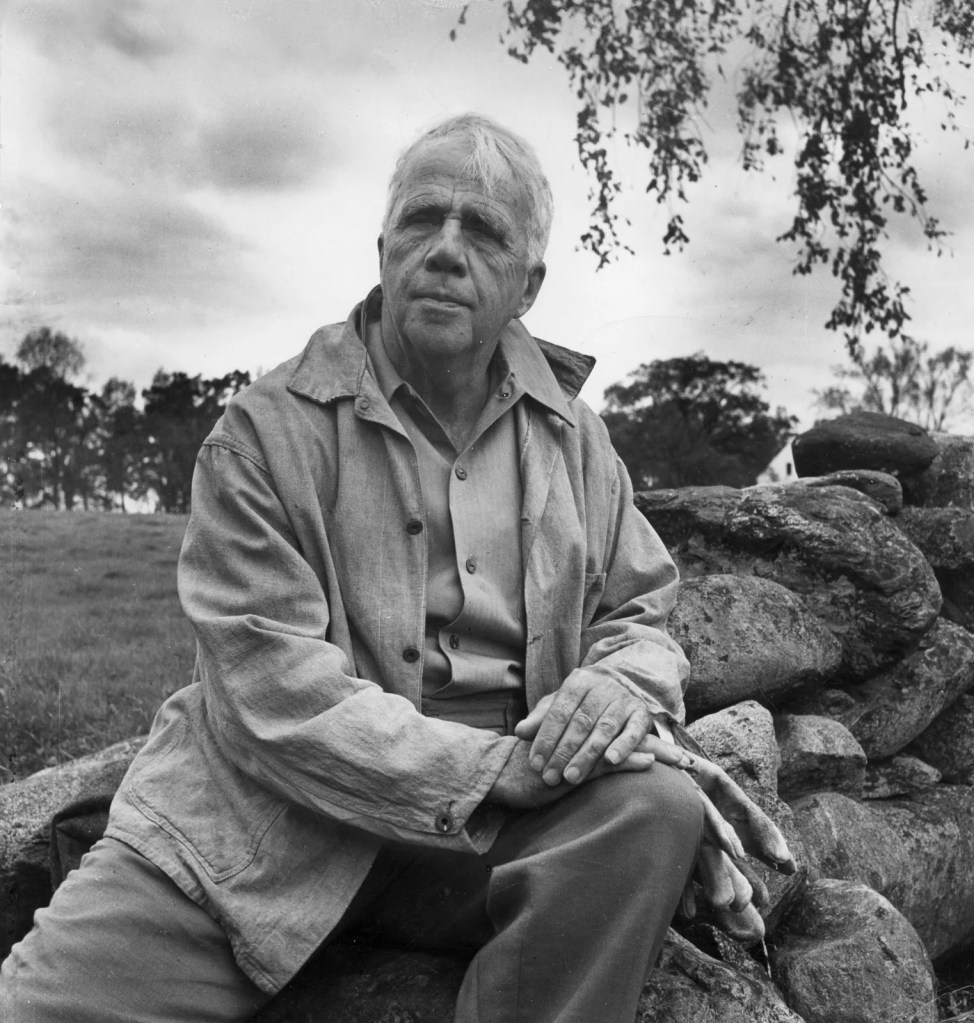
Frost understood. We all have wistful thoughts, fantasies, moments of nostalgia, moments of regret, and with our imaginations we can visit other domains; we can break away, put reality on hold “awhile,” until it’s time to return to the life we’re living now. I always feel refreshed and ready for the rest of winter when I read “Birches.”
Discover more from Dan Rodricks
Subscribe to get the latest posts sent to your email.

 Dan Rodricks
Dan, I’m so appreciative of your ‘work’!, i.e. your selection of subjects to be ‘discussed’, and then your consummate ability to express your thoughts in such a manner that we ‘common folk’ can understand your ‘message’, Blessings! Dave Meyers (aged 95 in the shade of life, i.e.!)
LikeLike
I hope your analysis of âBirchesâ for English 102 at the University of Bridgeport was as insightful as the one you wrote today.
Wonder assignment. A+
F. Lidinsky
To receive college credit for English 102, you are required to write two essays that ask you to address concepts from notable works in American literature. In order to write your essays, you are required to read a portion of the texts listed below. Read on for details about your choice of readings for the major eras of American literature. Updated: 12/29/2023
About This Resource
For this course, you are required to read 12 total texts that are representative of different eras of American literature. Before you complete your proctored final, you will be required to submit two assignments that will ask you to compare various elements found in the mandatory readings. You are required to read at least one text from each era, and note that for some of the eras listed below, you may choose which of several works you’d like to read.
Reading List
Modernist Poetry in American Literature – Please read one of the following:
Robert Frost: ”Mending Wall” * Robert Frost: ”Birches” * Adrienne Rich: ”Aunt Jennifer’s Tigers” (found in chapter 2, lesson 4) * T.S. Eliot: ”The Love Song of J. Alfred Prufrock”
LikeLiked by 1 person
Dan, I love your writing. To me, you are as much a gift as Frost was. Your memories of the town we called “home” bring me smiles and longing and comfort. “You didn’t jump to the ground, the birch delivered you back to earth”. I remember.
LikeLiked by 1 person
Loved it!
Rae Eberwine
Bel Air
LikeLiked by 1 person
Danny,
You bring Frost’s poem alive, I pictured you vividly walking through snow by the Matfield River!
My all time favorite of Robert Frost’s is Stopping by the woods on a Snowy Evening.
“ I have miles to go before I sleep…
“ have miles to go before I sleep”
LikeLiked by 1 person
So, Ms. D’Emilia – do I get an A?
LikeLike
Dear Mr. Rodricks,
Thank you so much for writing thoughts very close to my own about this poem. It holds so many memories for me, perhaps the dearest of which is my father starting each winter with the ritual of playing his cherished record of Frost reading this poem and others, Frost’s voice the voice of an old man, but reading his poems exquisitely. Like you, I read this poem at the start of winter. I hear it in my mind (in the voice of Frost on my father’s record) when I wake up on a winter’s morning to find the trees covered in ice. A woman of 70 now, I still like to dry my hair the way the girls in the poem do. And, of course, I always imagine that I am in the poem–a young girl, on a warm summer’s day, existing in Frost’s memory of summer on an icy winter day–when I do.
I came across your blog completely by chance. I will be following it from now on.
LikeLiked by 1 person