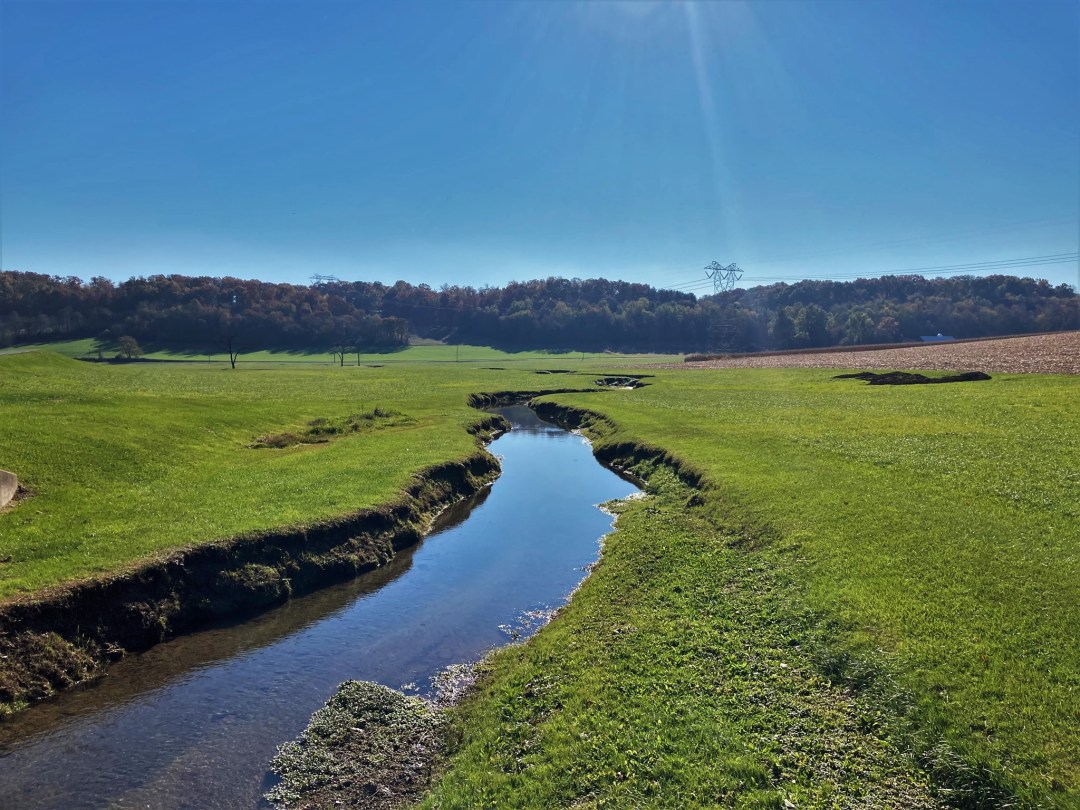
Driving through Carroll County one sunny day, I came upon this place where the road crossed the South Branch of the Gunpowder Falls and could not believe what I was seeing — a property that looked like a golf course, except it wasn’t a golf course. It was a vast field without a single tree. The South Branch meandered through the property, completely exposed to the summer sun. The sprawling pasture had been mowed right up to the stream bank.
Some people find this sort of landscape beautiful. I think it’s a hideous waste, a lost opportunity to turn back the clock to a greener, richer used-to-be, and to improve water quality that flows to the Gunpowder and, eventually, to Baltimore reservoirs. It also represents hundreds of gallons of fossil fuels burned to keep the place mowed.
It’s not my property. I have no say in this. But I’ll never understand why people spend so much money to have a place look like this when they could plant trees and have a forested vista that is much healthier for all life around it.
Look at the photo and imagine the South Branch cutting through a forest thick with hemlocks. That’s probably what was there in the early 18th Century, when the area was first settled. The South Branch was probably robust and thriving with brook trout. Then came the colonial settlers with the ax and plow, then came mills and waterwheels. In time, the trees were gone — Maryland lost 97% of its forest between the 17th and late 19th centuries — and the land turned to pasture and crops. The streams became muddy and warm, or they were blocked by dams. The exquisite brook trout that had lived in them for ages disappeared. Some of the little creeks they left behind ended up looking like — and serving as — drainage ditches.
That probably lasted 100 years, maybe 200 years. But, at some point, the farming apparently stopped, and the landowner decided he liked how his field looked in this mowed, treeless state. I shake my head. If I owned that place, there would be a new forest rising, providing a vast, shady canopy for the precious water. The land would be in a conservation trust. But, alas . . .
Climate change looms over everything, and makes the small, local efforts at environmental healing — like those described today in my Sun column — seem unimportant. But they’re not. Even in this cynical age, we need to keep our vigilance and our stewardship. If you own land with a small creek that looks like nothing more than a ditch, learn to love it and plant trees. You might reverse the damage done by earlier generations. You might even see brookies again. Time and technology push us forward, always forward, but some things are worth a trip backwards, to the greener, richer used-to-be.
Discover more from Dan Rodricks
Subscribe to get the latest posts sent to your email.

 Dan Rodricks
Our local park has a history over the past 50 years. We’ve lived in the neighborhood for 26 of those. In the 70s there were houses near a creek. Then the houses were gone, but the stream was still polluted. Then residents and the county worked on flood abatement, planting cattails and grasses in a marshy area and trees nearby. Today we have a park with a stream that doesn’t smell and at the very least, the water is clean enough to see the bottom.
So yeah, a little effort and a few bucks and we have something nicer than we had when we moved here. That’s not too much to ask, is it?
LikeLiked by 1 person
Three years ago I stopped mowing my fenced in backyard. Numerous blossoming plants have taken hold, many are native flowers. And the yard is filled with honey bees and fireflies. Visitors remark how pretty it is, which surprised me. And it is peaceful and calm with young rabbits and birds.
LikeLiked by 1 person