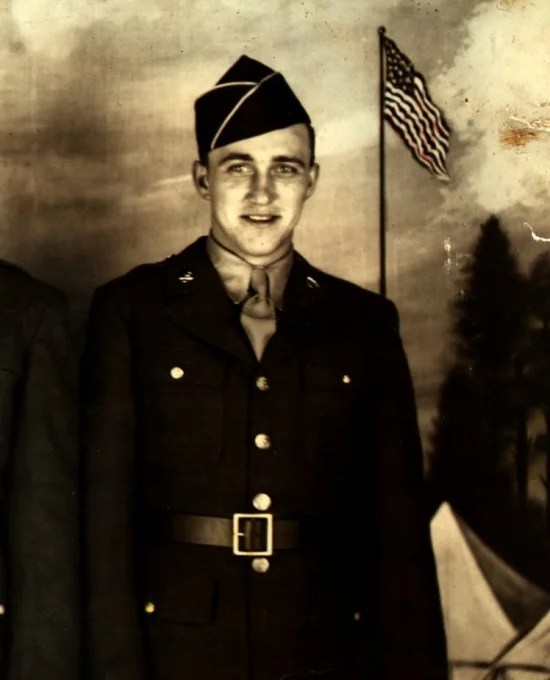
Those who were in the audiences for my play, “Baltimore, You Have No Idea,” might recall the story of Private John Kreiner. I spoke of him from the stage: A young soldier from Baltimore who died in the U.S. Army’s liberation of a small French village that had been occupied by Nazi Germany for four years. Kreiner was fatally wounded by machinegun fire in a meadow near Sauvagney in eastern France in 1944. The people of the town buried him in the churchyard; his remains were later interred at the Epinal military cemetery at Dinozé, about 80 miles to the north.
Several years ago, Henri Ducret, the mayor of Sauvagney, solicited my help in locating Private Kreiner’s surviving family members in the Baltimore area. My columns notified the family about the dedication of the village’s memorial to Kreiner.
I have been in touch in recent years with Daniel Ducret, the son of the late mayor.
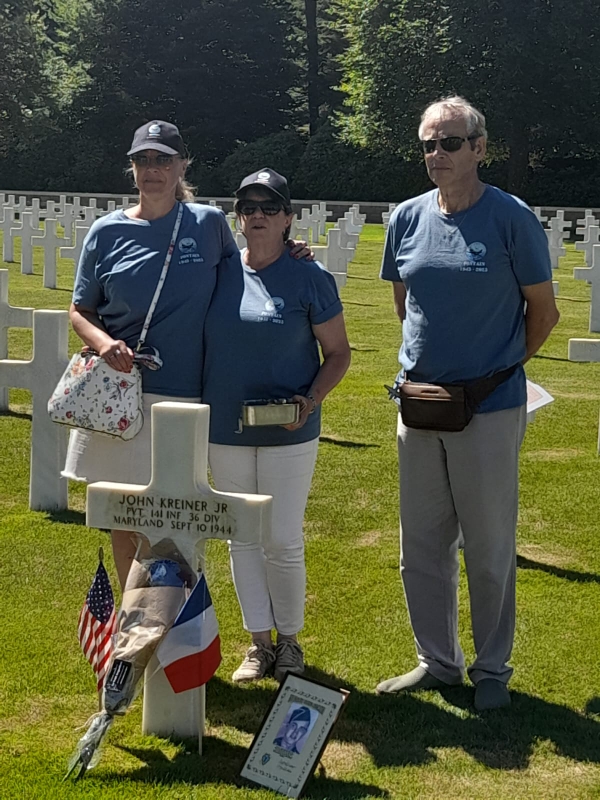
The people of Sauvagney, descendants of those who were there on Sept. 10, 1944 when American soldiers freed them from fear and fascism, remain grateful for Kreiner’s sacrifice.
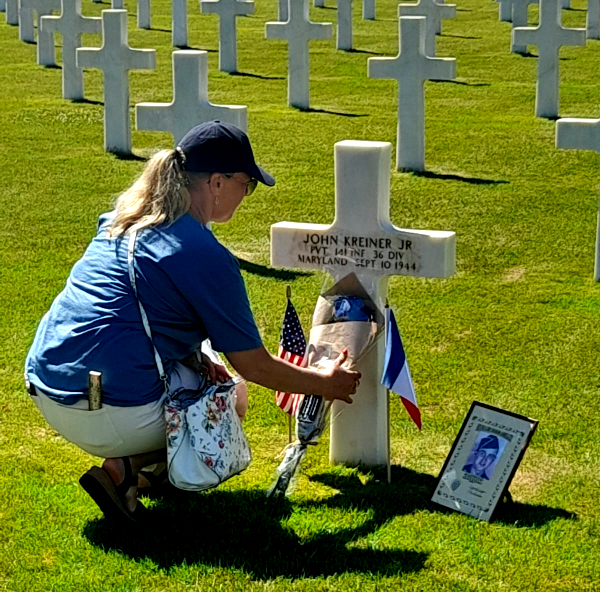
Over the past weekend, Daniel Ducret, his wife Elizabeth and daughter Aurore visited Epinal-Dinozé. They used sand from Omaha Beach to clean his cross. As you can see from the photos, they also placed flowers, flags and a framed photograph of Private Kreiner at his grave. “My wife,” says Mr. Ducret, “is now the godmother of John Kreiner Jr.’s grave.”
I hope you find it as powerfully moving as I do: The lasting gratitude of people whose relatives and countrymen were liberated by a generous and strong America willing to fight and sacrifice for freedom and democracy abroad. Now we must fight for it at home.
Discover more from Dan Rodricks
Subscribe to get the latest posts sent to your email.

 Dan Rodricks
Dan – Thank you for sharing Private Kreiner’s courage and sacrifice. One of my Baltimore relatives was able to come home from that war. We should pray for them all.
LikeLiked by 1 person
This short piece causes a lot of heartfelt emotion and gratitude for John Kreiner. There are probably a million stories of heroism and decency from WWII. I hope we learn of an equal number of heroic stories as we fight against a similar enemy. albeit one that’s home-grown, 80 years later.
Thanks for a positive note in the face of almost constant depressing news from our government. Sigh. m.
LikeLiked by 1 person
My Northern Irish father fought in a famous Ulster regiment of the British Army in WW2, in North Africa, Sicily, and Italy. One of his US comrades in that tough fight was a Baltimore German-American Army soldier, Paul Lemberger. Dad was a journalist and had the opportunity to be a war correspondent but he wanted to fight, not write. Paul received copies of The Baltimore Sun from his family, and would give them to my Dad, who was an admirer of star Sun nationally syndicated columnist, Henry Louis (H.L.) Mencken. For years, Dad carried paperback copies of Mencken’s books in his briefcase when he returned to “Civvy Street,” and he shared Mencken’s writing with me when I was a teenager. Baltimore, like Belfast, was a great harbor city, a major port which built liners and battleships, aircraft, and munitions, so I knew about Baltimore long before I first visited it when I came to work in the USA. I have Dad’s copy of Mencken’s “The American Language” and it sits in our home library near Dad’s Empire Aristocrat metal-cased portable typewriter, on which Dad’s columns and thousands of stories were written. And I am married an Irish-American Baltimore beauty from Roland Park!
LikeLiked by 1 person