During the pandemic, The Boston Globe posed this question to its readers: “What changes from pandemic life are worth keeping?”
My answer: Knowing better my space, appreciating what’s right in front of me, and finding treasure in the process.
One morning after a heavy rain, I picked up and examined a branch that had snapped off a tree in my Baltimore neighborhood. I might not have done this before the pandemic and the big everything-slowdown of 2020. But when you’re forced to stay close to home and keep your distance from strangers, you find yourself associating with things that do not cough or sneeze.
Like trees.
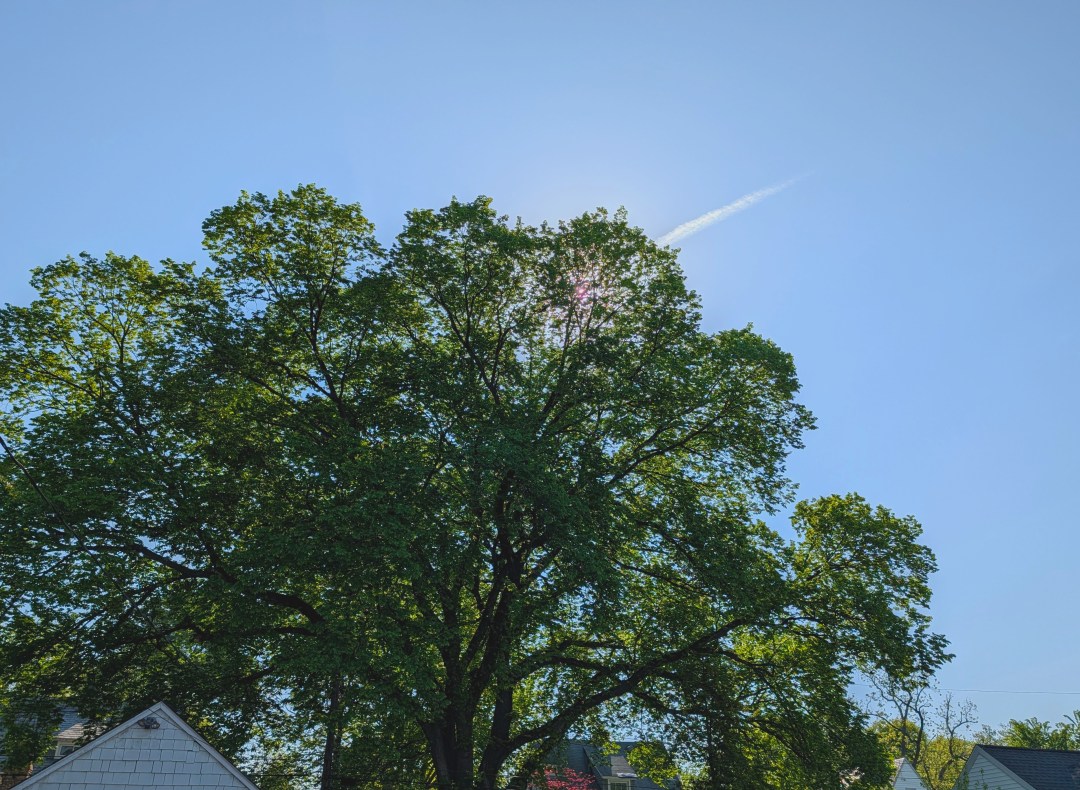
This one in my neighborhood is gorgeous, with a thick trunk reaching up 25 feet, then sprawling in all directions with 40- and 50-foot limbs that, in summer, are flush with leaves. The crown must top out at nearly 100 feet. The tree, situated at the corner of one yard, provides shade for four, and its jaw-drop beauty is available to anyone who takes a minute to look up.
What kind of tree is it? I had never bothered to check until that moment of the fallen branch.
The green leaves were about two inches long. They had saw-toothed edges and pointy tips, and the surface of each felt like sandpaper.
I took a picture of the leaves and submitted it to the iNaturalist app on my phone. The little genius inside took one look and identified the tree as Ulmus americana — that is, an American elm.
Now let that sink in. If you don’t get the significance, you will in a minute.
Dutch elm disease was an arboreal pandemic, killing millions of beautiful trees in Europe, then North America over the last century. American elms once beautified and shaded city boulevards and small-town main streets (Elm Streets!) I remember seeing dying ones cut down and hauled away when I was a kid in East Bridgewater, Mass. I considered them part of America’s past, as bygone as the passenger pigeon.
So, learning that this big, healthy tree was an American elm came as a mild shock. Erik Dihle, then the city arborist, confirmed it. So did tree lover Sarah Lord and arborist Amanda Cunningham, both members of the Baltimore City Forestry Board. They came out to see the elm and were impressed. Cunningham estimated its age at about 100 years.
I had to weigh that: It meant someone had planted the elm around the time of the 1918-1919 pandemic. I felt we had an old and unappreciated war hero in our midst. Now it’s back for another season, looking healthy, and I thought you might want to know. How lucky we are to have this survivor still breathing life into the neighborhood.
Discover more from Dan Rodricks
Subscribe to get the latest posts sent to your email.


Thank you Dan, what a beautiful piece. We certainly take trees for granted, or worse, treat them as impediments to progress.
LikeLiked by 1 person
Thanks! N
LikeLiked by 1 person