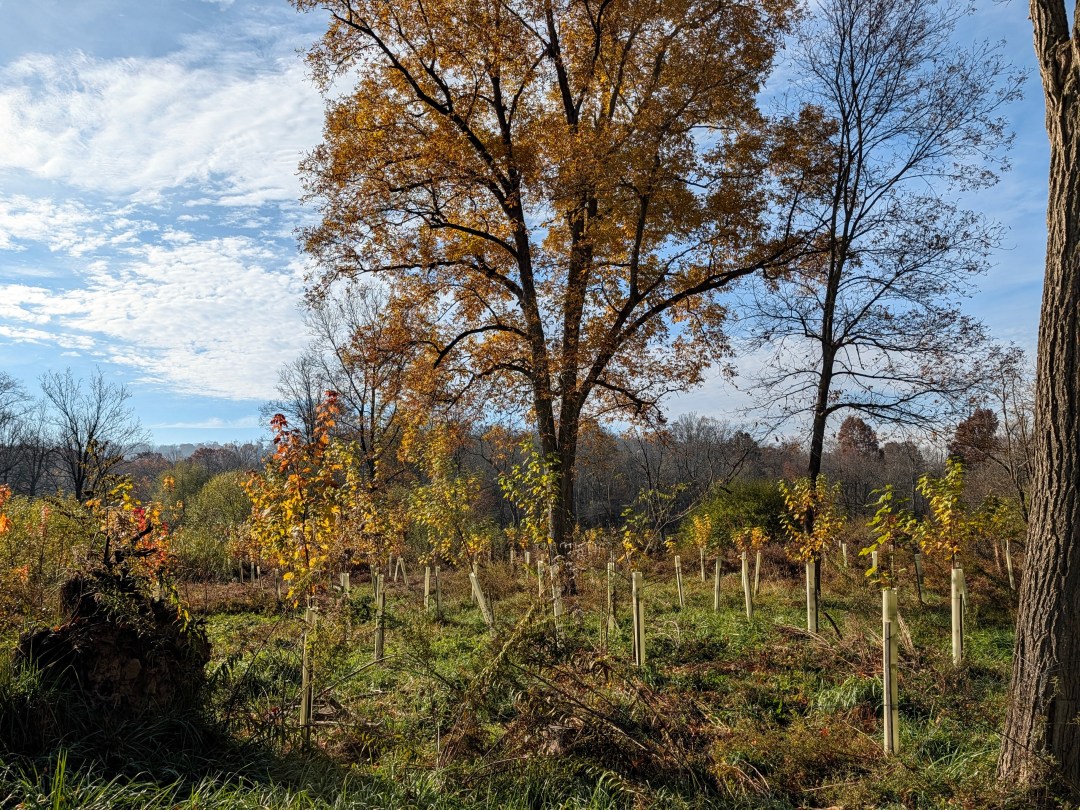
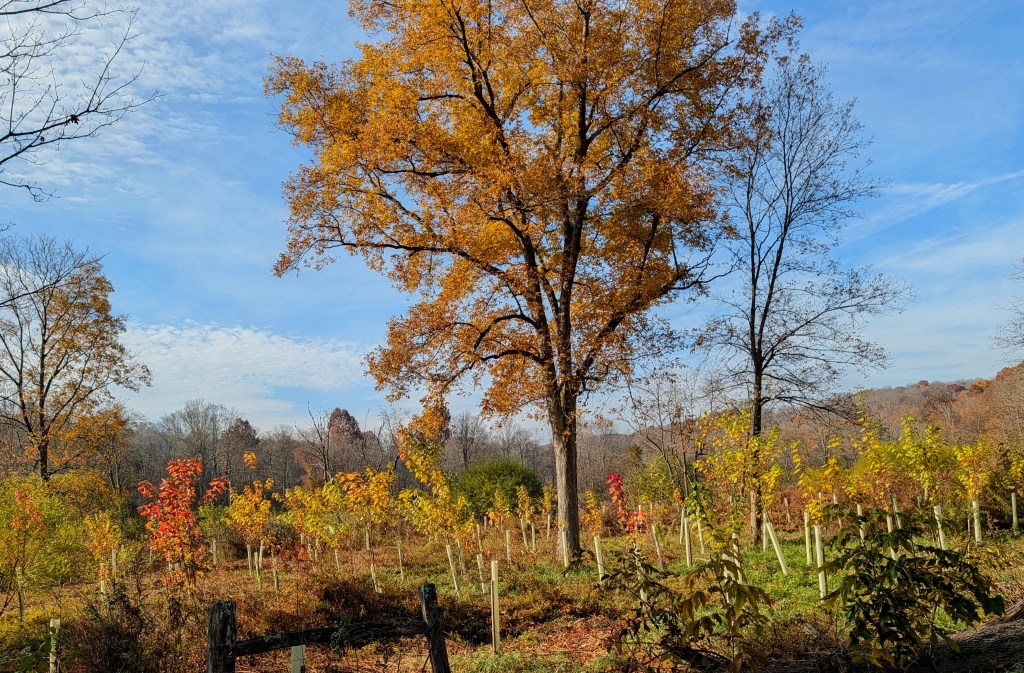
After seeing the terrible images of hundreds of old trees being cut down at the historic East Potomac Golf Course in Washington, I wondered how this Western Maryland project — to plant trees to improve the quality of a small stream — worked out. So I drove along River Road in Grantsville, Maryland, where Ben Harris of Trout Unlimited and some Amish farm boys had planted trees two years ago… and, voila, the project looked pretty good in the morning sun.
Here are before (August 2024) and after photos (October 2026):
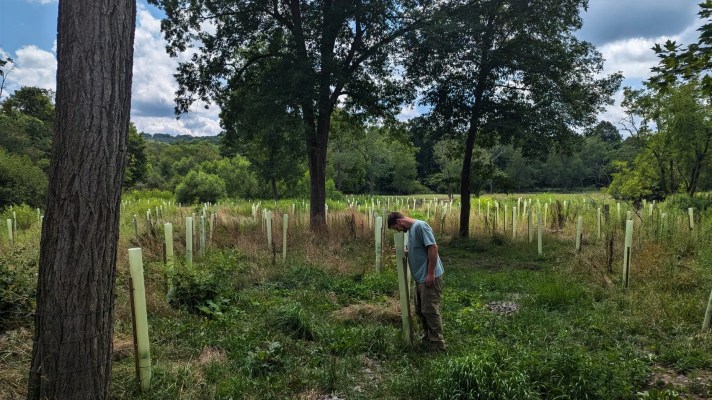
Here’s the background, from my Sun column of August 27, 2024:
Dressed for work in khakis and a T-shirt, Ben Harris stepped down from where we had just parked — on River Road in Grantsville, Garrett County — and he craned his neck into five-foot tubes to assess the progress of trees he and the Amish lads had planted in a farm field.
“Lots of leaves!” Harris called out, expressing the glee of a young farmer seeing his hard work sprout through soil.
Though Harris is not a farmer, his job puts him in contact with them and other landowners in Maryland’s westernmost county. He manages Trout Unlimited’s project to improve habitat and water quality for native brook trout — a beautiful fish that has managed to survive 300 years of human invasion, from colonial settlements through coal mining, suburbanization and now the climate crisis.
Our remaining native brook trout populations are primarily in Garrett County and in the Gunpowder Falls watershed northwest of Baltimore. They have been imperiled by the loss of habitat and by the centuries-long degradation of the little veins of water that flowed through dense forest before farmers cleared land for crops.
The big concern now is the effect of climate change on water temperatures. Brook trout need cold water. They need to be able to migrate to it during the hottest times of the year. They need to be able to spawn without abnormal flooding blowing out their redds, or nesting beds.
About 40% of Maryland’s brook trout waters are on privately owned land. So Harris’ duties include convincing people to plant more trees along the creeks, licks and runs that flow through their properties. A healthy and full tree canopy can help offset Code Red temperatures.
The Amish farmer on River Road, along the Casselman River, was glad to get what Harris offered — hundreds of maple trees for his maple sugar operation, fencing to keep his cows off a small creek, and more trees in the lower part of his property near the river. All Harris had to do was guarantee that the trees were privately funded — from the local chapter of Trout Unlimited and other organizations — and not in any direct way connected to government. (While they pay taxes, the Amish prefer not to receive benefits from government programs.)
The farmer’s two sons helped Harris do the spring plantings. The tubes protect the trees from deer. Some of the landowners he’s approached find the tubes unsightly, Harris says, but, if all goes well, they can usually be removed after three years.
The trees on the Amish property will reforest a section of land where a small creek flows to the Casselman. The creek provides summer passage for the brook trout to areas upstream where they find cool water from springs. (Brook trout survival typically requires water temperatures below 68 degrees.)
Planting trees has a huge effect on just about everything.
“It’s good for the birds,” Harris says. “It’s good for bugs, good for fish, good for water temperature. There’s all kinds of things that trees do that nothing else does. … The best thing you can do, from a habitat standpoint, is plant trees.”
And there are funds available for that, Harris says.
Even so, as he and volunteers with the Upper Gunpowder Falls Watershed Brook Trout Conservation Partnership have learned, some landowners prefer big lawns or open fields mowed right up to the banks of a stream.
Driving through Carroll County, I came across the South Branch of the Gunpowder Falls and could not believe what I was seeing — a property that looked like a golf course, except it wasn’t a golf course. It was a vast field without a single tree. The South Branch coursed through the property, completely exposed to the summer sun.
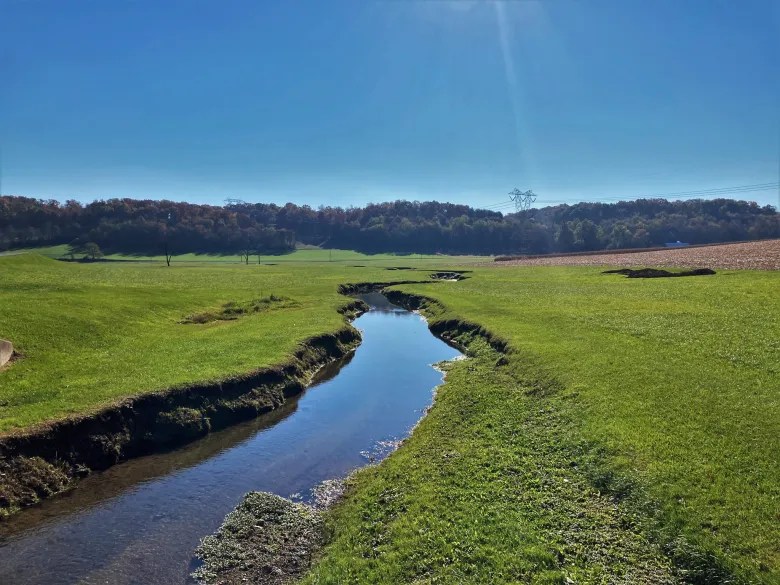
Some people find this sort of landscape beautiful. I think it’s an awful waste, a lost opportunity to improve water quality and habitat for the brook trout. It also represents hundreds of gallons of fossil fuels burned to keep the place mowed.
You can’t force people into being good stewards of their land. But you can at least try to convince them of the value of planting trees. That’s what volunteers with the Upper Gunpowder project have been doing for several years because the basin north and west of Prettyboy Reservoir supports the second-highest number of brook trout in the state, about 25% of the Maryland population.
River Valley Ranch, the summer youth camp and retreat in Carroll County, got into the act with a grant from the state in 2019. The Gunpowder flows right through the place and Muddy Creek meets it there. The project resulted in plantings along the stream banks to reduce erosion and improve habitat for brook trout.
But there’s a lot more to be done throughout the vast Gunpowder watershed. A lot of landowners need to plant trees. Autumn is a good time for that. Plant trees, save the brookies, save the planet. I think I just wrote the bumper sticker.
Discover more from Dan Rodricks
Subscribe to get the latest posts sent to your email.


Infuriating
LikeLiked by 1 person
So m many years to get new trees to beautiful maturity again 🙁🙎🤨
LikeLiked by 1 person
So many years to get new trees to beautiful maturity again 🙁🙎🤨
LikeLiked by 4 people
I know. But what else can we do?
LikeLiked by 1 person
Thanks. The perils of too many environmental science classes with a protagonist professor. Even the smallest pond has a massive hidden ecosystem. A tree which falls, slowly degrades and splits, the same thing. Loved those college field trips minus one slip backward into a puddle and wet butt along the the Mason Dixon at Antiam Creek area not far from Cacocton and Camp David (every time we went to the forest we were warned we would not have a signal which was the only reason I realized we were so close to Camp David) area was so interesting. Thanks for the info. I shall follow up.
LikeLiked by 1 person
GOOD
LikeLiked by 2 people
Beautiful ❤️
LikeLiked by 1 person
Beautiful trees
LikeLiked by 2 people
Hi can l ask you questions? I’m new
LikeLiked by 3 people
Sure
LikeLiked by 2 people
And May I use your answers in my article?
LikeLiked by 2 people
About what?
LikeLiked by 1 person
Why did you choose journalism? What is a typical workday like for you? What is the most interesting and challenging part of your job?How do you check that information is reliable?Which article or report are you especially proud of?What advice would you give a student who dreams of becoming a journalist?
LikeLiked by 1 person
Such an inspiring and hopeful post, Dan! I completely agree with what lkm1960 was sharing down in the comments about how eye-opening those field trips and hidden stream ecosystems are. Seeing those success stories makes all the difference when looking for ways to combat eco-anxiety.
LikeLiked by 3 people
Terrible
LikeLike
Yes, what Trump did was terrible. What’s happened along the Casselman River 150 miles away good.
LikeLike